



Key Summary
Child development lays the foundation for emotional, cognitive, physical, and social well-being. Early intervention and consistent nurturing shape lifelong outcomes. Factors like parenting style, culture, environment, and even activities like gymnastics influence growth.
Many caregivers find it difficult to strike a balance between screen time, emotional control, academic pressure, and playtime in today’s hectic world. Important facets of a child’s development may thus be neglected. A child’s learning capacity and future relationships can be negatively impacted by neglecting any one area of their development, whether it be emotional, cognitive, or physical. Inadequate early development raises the risk of mental health problems, difficulties in school, and poor social skills.
Knowing the importance of child development enables educators, parents, and other caregivers to establish supportive environments that lay a solid foundation for the future. Every decision counts, whether it’s through supervised play, cultural support, or a caring daycare setting.
Table of Contents
What Is Child Development?
From birth through adolescence, a child’s physical, emotional, cognitive, and social abilities undergo gradual and cumulative changes that are referred to as child development. It includes everything from developing speech and motor skills to comprehending emotions and building relationships.
Although these developmental processes follow a predictable order, individual experiences, environment, culture, and genetics can all have an impact. Early experiences have a direct impact on brain development and architecture, according to the Centers for Disease Control and Prevention (CDC).
Parents, educators, pediatricians, and legislators who have an impact on the systems that create children’s environments must all comprehend this framework.
The Four Core Domains of Child Development
Each domain plays a crucial role in holistic growth. Ignoring one can create imbalances that affect the others.
1. Physical Development
- Includes both fine and gross motor skills, including hand-eye coordination, walking, and grasping.
- Influenced by sleep, food, exercise, and medical care.
- This WHO study claims that physical activity also promotes emotional and cognitive development.
2. Cognitive Development
- Involves using language, reasoning, memory, and problem-solving skills.
- Closely related to curiosity, interaction, and early educational exposure.
- Gymnastics is one activity that demonstrates the interdependence of domains by improving both spatial reasoning and physical coordination.
3. Social-Emotional Development
- Comprises self-awareness, empathy, relationship development, and emotional control.
- Fostered by safe surroundings, peer interaction, and attentive parenting.
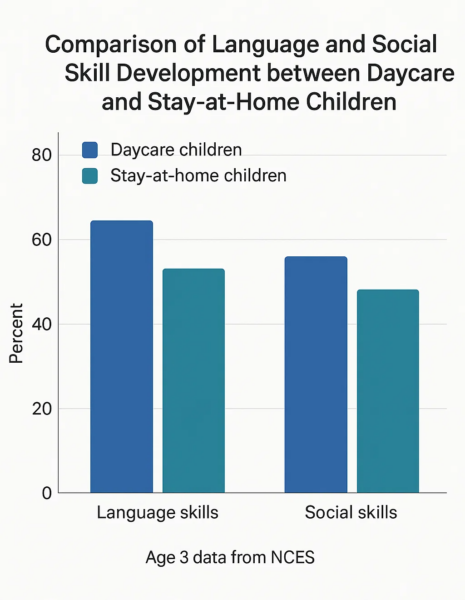
- Group settings can facilitate the development of social skills, as demonstrated by the comparison of childcare and stay-at-home learning.
4. Language Development
- Begins with cooing and babbling and progresses to full conversations.
- Heavily influenced by early reading, talking, and storytelling.
- Bilingual or multilingual households may experience different development patterns.
The Long-Term Impact of Early Development
The power of child development to influence a child’s eventual adulthood makes it significant. Experiences during the first five years of life have the greatest impact on brain development, according to research from Harvard’s Center on the Developing Child.
Early-stage poor development can result in learning challenges.
- Low self-worth
- Problems with behavior
- Health issues
- Adult socioeconomic challenges
On the other hand, a well-supported developmental path leads to improved interpersonal relationships, career success, emotional intelligence, and academic achievement.
Internal and External Influences on Development
While genetics set the blueprint, the environment shapes how that blueprint unfolds. Several internal and external factors influence developmental outcomes.
Internal Factors:
- Genetics
- Gender
- Health and disabilities
- Temperament
External Factors:
- Parenting style
- Socioeconomic status
- Cultural expectations
- Access to healthcare and education
- Cultural context influences how children learn social norms, values, and communication styles.
Understanding both is crucial for tailoring support systems that meet individual children’s needs.
Why Monitoring Milestones Matters
Tracking developmental milestones like first smiles, babbling, crawling, walking, and toilet training is more than just a checklist exercise. A child’s progress in the social, emotional, cognitive, and physical domains can be determined by these developmental milestones. By monitoring them, parents, educators, and health care providers can assess whether a child is developing normally or needs additional support.
Each developmental milestone provides important hints about the state of a child’s body and mind. A child’s delayed crawling, walking, or grasping of objects may indicate underlying neurological or muscular issues. Similar to this, speech delays can occasionally indicate problems with language processing or hearing. Early detection is crucial in this case because the sooner these symptoms are identified, the sooner kids can receive the assistance they require. Early intervention in the formative years, whether through speech, occupational, or physical therapy, can have a profound impact. Indeed, research indicates that children who receive assistance at an early age typically exhibit improved behavior, stronger communication, and greater readiness for school than children who receive a diagnosis later in life.
To support this process, caregivers are encouraged to:
- Use age-appropriate milestone checklists, like those provided by the CDC or local pediatric associations.
- Download milestone tracking apps (such as CDC’s “Milestone Tracker”) for real-time tracking and guidance.
- Engage in routine pediatric checkups, where doctors use developmental screening tools and growth assessments.
- Communicate openly with daycare providers, teachers, and therapists to compare observations across different settings.
Role of Imagination, Play, and Environment
Play and imagination are essential to learning; they are not extravagances.
- Storytelling, empathy, and decision-making are all enhanced through pretend play.
- Playing outside promotes physical health, resilience, and exploration.
- Risk-taking and creativity are encouraged in safe, stimulating environments
The Importance of Imagination in Child Development claims that imaginative play enhances social skills, brain development, and even the potential for future innovation.

Daycare vs. Stay-at-Home Development Outcomes
|
Factor |
Daycare Environment |
Stay-at-Home Environment |
|
Social Skills |
Enhanced through peer interaction |
Limited but deeper family bonding |
|
Language Development |
Accelerated via varied conversations |
Dependent on parent’s engagement |
|
Emotional Regulation |
Learned through group dynamics |
Modeled from caregiver responses |
|
Cognitive Stimulation |
Structured curriculum and activities |
Depends on parent resources and planning |
|
Physical Activity |
Group exercises, play areas |
Variable—depends on access to parks and time |
|
Exposure to Diversity |
Greater, diverse peers and staff |
Often limited to family culture |
|
Imagination & Play |
Structured and unstructured play are encouraged |
Unstructured play may dominate |
Frequently Asked Questions
At what age is it most crucial for child development?
The first five years are the most formative, especially for brain development, emotional bonding, and language acquisition.
Can a child catch up if development was delayed?
Yes, with early intervention and supportive environments, many children close the gap over time.
How does culture influence development?
Culture shapes beliefs, values, communication styles, and expectations. Learn more in our blog on How Does Culture Affect Child Development?
What role does play serve in development?
Play enhances creativity, problem-solving, emotional resilience, and physical coordination.
Final Thoughts
The first step to creating a better future for your child and society as a whole is realizing the significance of child development. Though brief, childhood has a lasting impact. We can create strong, compassionate, intelligent, self-assured people who are prepared to prosper in a complex world by being knowledgeable and deliberate.
References
- CDC. (2023). Child Development Basics.
https://www.cdc.gov/child-development/about/?CDC_AAref_Val=https://www.cdc.gov/ncbddd/childdevelopment/facts.html - Harvard University. Center on the Developing Child. Brain Architecture. https://developingchild.harvard.edu/homepage/
- WHO. (2022). Early Childhood Development.
https://www.who.int/health-topics/child-health#tab=tab_1
Comments are closed