



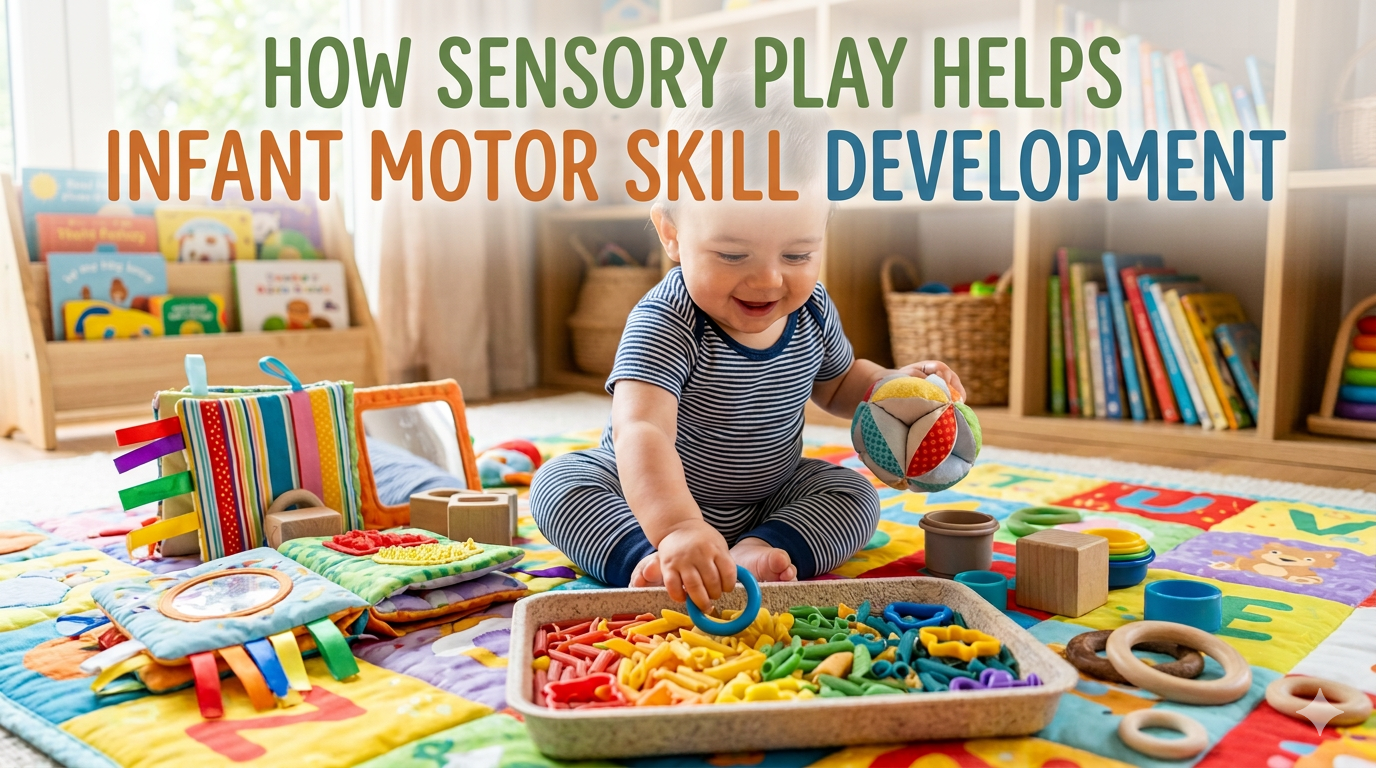
As parents, caregivers, or early educators, we often focus on teaching words or colors, but the foundation of your baby’s learning starts with movement and exploration. Sensory play is a cornerstone of infant development because it engages multiple senses, touch, sight, sound, and even smell, while naturally encouraging motor skill development.
From reaching for a soft toy to crawling over a textured mat, these simple activities stimulate fine and gross motor skills, coordination, and even problem-solving abilities. The more opportunities infants have to interact with their environment, the stronger their physical and cognitive foundations become.
Table of Contents
Understanding Motor Skills in Infants
Motor skills are divided into two main categories:
- Gross Motor Skills – These involve large muscle movements like rolling, crawling, standing, and eventually walking. Sensory play supports these skills by encouraging infants to move their arms, legs, and torso in safe, stimulating ways.
- Fine Motor Skills – These involve precise movements using smaller muscles, particularly in the hands and fingers, such as grasping toys, picking up objects, and feeding themselves. Sensory activities that require squeezing, poking, or manipulating objects help refine these abilities.
According to experts at the American Academy of Pediatrics, Infants learn best through active engagement with their environment. Sensory-rich experiences accelerate both motor and cognitive development.
How Sensory Play Enhances Motor Skills
Sensory play creates a multi-sensory learning environment that directly impacts motor skill development in several ways:
1. Strengthening Muscles and Coordination
Activities like tummy time, crawling over textured surfaces, or reaching for colorful toys encourage muscle engagement. This strengthens arms, legs, neck, and core muscles, forming the foundation for walking, climbing, and self-feeding.
2. Improving Hand-Eye Coordination
Sensory toys that encourage grasping, stacking, or transferring objects help infants coordinate their hands and eyes, improving precision and timing for future tasks like writing and catching objects.
3. Encouraging Balance and Spatial Awareness
Movement-based sensory play, such as rolling balls, climbing soft obstacles, or navigating sensory mats, promotes balance and body awareness. Infants learn to judge distances, adjust posture, and move safely, which is crucial for independent mobility.
4. Stimulating Problem-Solving Skills
Even simple activities, like figuring out how to stack blocks or fit shapes into a sorter, combine cognitive and motor skill development. The brain and body work together to plan movements, adjust grip, and coordinate actions.
Top Sensory Activities for Infant Motor Development
Here’s a list of easy, safe, and effective sensory activities to encourage motor skill growth:
Activity | Motor Skill Benefits | How to Do It |
Tummy Time | Strengthens neck, back, and shoulder muscles | Place your baby on their tummy for short periods daily, using toys to encourage reaching. |
Textured Play Mats | Enhances tactile exploration & crawling | Use mats with different textures and patterns for crawling and rolling. |
Stacking Blocks | Improves fine motor skills & hand-eye coordination | Encourage the baby to pick up and stack soft blocks of varying sizes. |
Water Play | Develops grasp & sensory exploration | Supervised splashing with cups or floating toys in a shallow basin. |
Finger Painting | Promotes sensory integration & fine motor strength | Use safe, edible paints to allow exploration and grip practice. |
Rolling Balls | Improves coordination & balance | Gently roll balls to your baby and encourage them to push or catch. |
Parents who want more hands-on ideas can explore our detailed guide on Sensory Activities for Infants, which shares age-appropriate sensory games designed specifically to support early brain and motor development.
Expert Tips for Maximizing Benefits
- Follow Baby’s Lead: Allow infants to explore at their own pace. Over-stimulation can hinder rather than help development.
- Rotate Toys and Textures: Introducing new textures, sounds, and shapes keeps the sensory system engaged.
- Create Safe Spaces: Use soft mats, cushions, and non-toxic toys to ensure exploration without risk of injury.
- Combine Social Interaction: Play alongside your infant—singing, clapping, or talking encourages imitation and social motor skills.
Frequently Asked Questions
When should I start sensory play with my infant?
Sensory play can begin from birth, starting with simple tummy time and progressing to more interactive activities around 3–6 months.
Are there any risks with sensory play?
Only ensure toys are age-appropriate, non-toxic, and that babies are supervised during play, especially with water or small objects.
How long should sensory play sessions last?
Short, frequent sessions (5–15 minutes) are best for infants. Gradually increase duration as they grow.
Final Thoughts
Sensory play is much more than a fun pastime; it is a critical driver of motor skill development in infants. Through simple, everyday activities, parents and caregivers can help babies develop strength, coordination, balance, and fine motor precision while stimulating cognitive growth.
Start small, make it playful, and watch your little one thrive physically and mentally. The skills they gain now will lay the groundwork for confident, active movement for years to come.
Comments are closed