Key Summary
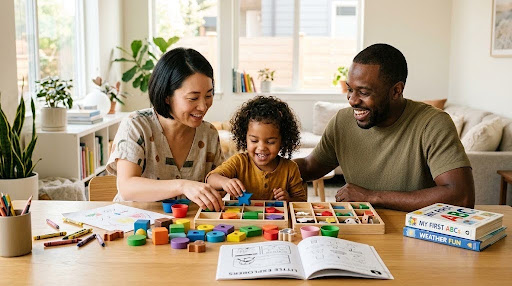
Educational activities for kids work best when they are hands-on, age-appropriate, and built into everyday play. A book, blocks, crayons, household items, or a walk outside can become a learning opportunity without expensive kits or formal lesson plans.
Table of Contents
Quick Answer
Some of the most fun educational activities for kids include letter and sound games, counting and sorting, shape and color hunts, reading and storytelling, simple STEM experiments, building challenges, sensory play, art, riddles, nature walks, role play, music and movement, screen-free games, and everyday cooking or household helpers.
Kids’ educational activities don’t have to be complicated; they can be fun and easy to do at home. Children can practice early literacy, math, science, creativity, problem-solving, and social abilities through everyday play.
You don't need expensive learning kits or a lesson plan. A book, some blocks, household items, crayons, or a walk outside can all be a learning opportunity.
The key is to choose hands-on activities that are age-appropriate and allow children to explore, ask questions, make choices, and have more than one try. Repetition and daily routines can be especially useful for young children.
Educational Activities for Kids by Learning Skill
Different activities can support different skills. You don't need to teach everything at once.
| Skill | Easy activity |
|---|---|
| Early literacy | Letter hunt or story retelling |
| Vocabulary | Picture naming or storytelling |
| Math | Counting and sorting |
| Shapes | Shape hunt |
| Fine motor skills | Playdough or drawing |
| Problem-solving | Building challenge |
| Science | Sink-or-float experiment |
| Creativity | Art or pretend play |
| Social skills | Turn-taking games |
| Observation | Nature hunt |
10 Creative and Educational Activities for Preschoolers at Home
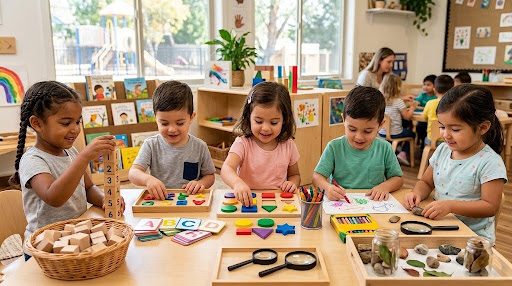
These short activities use materials you likely already have and work well for toddlers and preschoolers.
1. Alphabet and Letter Hunt
Pick one letter and ask your child to find items around the home that are associated with the sound of that letter.
For instance: B for ball, book, bottle; C for cup, car, crayon.
For toddlers, the emphasis is on becoming familiar with the letter and its sound. Preschoolers can aim to find multiple items that make the same sound.
Supports: letter recognition, phonological awareness, vocabulary, listening.
2. Counting Treasure Hunt
Give your child a counting challenge. Say something like, “Can you find five blocks?” Then try asking, “Can you find two more?”
Count toys, blocks, spoons, socks, books, or other safe items around the house. This is a great way to sneak in some early numeracy!
Supports: counting, number recognition, one-to-one correspondence, early addition.
3. Shape Hunt Around the House
Ask your child to find a circle, a square, a triangle, and a rectangle.
A plate may be a good example of a circle. The window could be a rectangle. The block your child is playing with may have a square side. See if you can find more examples!
Look for more fun shape ideas here: 25 Fun Shapes Ideas for Preschool, from Talk EarlyEd.
Supports: shape identification, spatial relations, vocabulary, observation.
4. Color Sorting Game
Gather a variety of safe objects in different colors and ask your child to sort them based on color. Once they’ve mastered dividing objects into two groups, you can ask them to add more groups.
Ask them questions like, “Which group has more?” and “Can you find me something blue?”
Supports: color recognition, sorting, comparing, early mathematical thinking.
5. Story Retelling
Read a picture book together. Ask your child questions about the story, such as who the characters were, what happened first, what happened next, how the character felt, and what might happen next.
Let your child retell the story in their own words. Reading and storytelling are important parts of a child’s early language development.
Supports: vocabulary, comprehension, memory, communication, and sequencing.
6. Sink-or-Float Activity
Get a container of water and a variety of safe objects. Before testing which objects sink or float, ask your child, “Do you think this will sink or float?”
Once you test the objects, talk about how your guesses compared to the results.
Supports: observation, prediction, early scientific thinking, and vocabulary.
7. Build a Tower
Give your child blocks or other building materials and encourage them to build. You can give them challenges such as building the tallest tower, a tower with 10 blocks, a bridge, a house, or a stronger structure.
Ask, “What can we change so it doesn’t fall?”
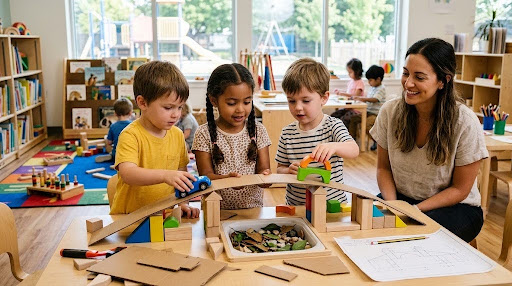
Supports: problem-solving, fine motor skills, spatial relations, and early engineering concepts.
8. Sensory Discovery Activity
Make a sensory bin for your child. Ask your child to observe and describe the items in the bin. Encourage words like soft, hard, smooth, rough, heavy, light, wet, or dry.
Use materials that are safe and developmentally appropriate for your child. Toddlers should always have supervision when using sensory bins.
Supports: sensory processing, vocabulary development, fine motor skills, and attention.
9. Make Your Own Story
Draw or print out simple pictures. For instance, you could draw a dog, then a house, then a tree. Let your child make up a story that uses these pictures. There is no right or wrong answer!
For toddlers, you may need to help them identify the pictures. Preschoolers can tell their own stories with a beginning, middle, and end.
Supports: language development, creativity, and sequencing.
10. Riddles and Thinking Games
Try some riddles! They’re a great way to make language practice fun and engaging. Here’s an example: What has teeth, but can’t bite? The answer is a comb!
Don’t focus on whether your child gets the answer right or wrong. Ask them how they figured it out!
You can find many more riddle ideas here: 35 Riddles for Kids With Answers.
Supports: listening, vocabulary, reasoning, language, flexible thinking.
Educational Activities for Toddlers
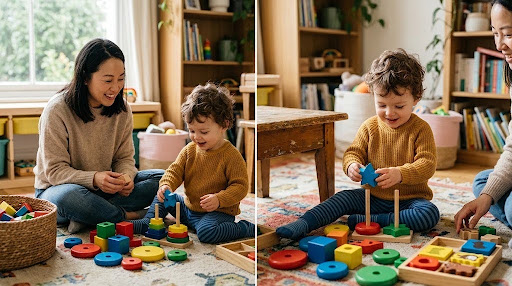
Toddlers learn best through movement, repetition, exploration, and interaction. Try keeping educational activities for toddlers brief and simple.
- Sort Everyday Objects: Sort large, safe objects by color, size, or type.
- Picture Book Talk: Point to pictures and name animals, objects, colors, and actions. Instead of only asking “What is that?”, add language like “That's a dog. The dog is running.”
- Music and Movement: Sing a familiar song and encourage your child to clap, march, jump, or copy your movements.
- Pouring and Transferring: During supervised water play, let your toddler move water between cups and containers.
- Household Helper Game: Let your child help with simple, age-appropriate tasks such as sorting laundry or putting toys into a basket.
Educational Activities for Preschoolers
Preschoolers can handle a little more structured learning, but they still learn best when activities feel playful.
- Matching characters
- Name recognition games
- Counting items
- Pattern activities
- Shape hunts
- Playdough letters
- Sequencing stories
- Simple puzzles
- Nature collections
- Make-believe grocery stores
- Building challenges
- Drawing and painting
- Easy science experiments
Mathematical concepts can be introduced naturally to preschoolers through everyday activities such as counting objects, measuring, and using number words.
Educational Activities for 2-, 3-, 4-, and 5-Year-Olds
You can often adjust the same activity by age.
| Age | Try | Make it harder by |
|---|---|---|
| 2 years | Sorting, naming pictures, stacking blocks | Add simple choices |
| 3 years | Counting, shapes, simple stories | Ask “why” and “what next?” |
| 4 years | Letter games, patterns, STEM activities | Add rules or multiple steps |
| 5 years | Reading, math games, building challenges | Ask children to explain their thinking |
Educational Activities for Kids at Home
You can create educational activities at home without buying special materials. Try these easy ideas:
1. Laundry Sorting
Sort clothing by color, size, or type.
2. Kitchen Math
Count ingredients, compare amounts, or divide something into equal portions.
3. Grocery Store Pretend Play
Create a pretend store using empty food containers. Children can practice counting, vocabulary, sorting, and social interaction.
4. Home Letter Hunt
Choose a letter and look for it on books, labels, signs, or packaging.
5. Indoor Nature Investigation
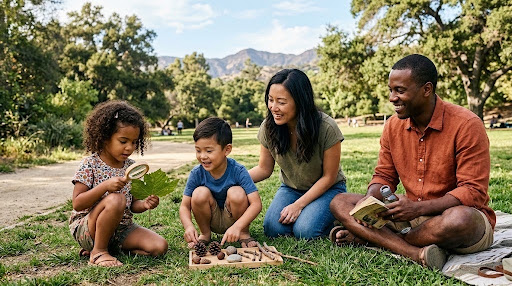
Look at leaves, flowers, rocks, or other safe objects collected outside and compare their colors, shapes, and textures.
6. Build With Recycled Materials
Use boxes and cardboard tubes to create a house, vehicle, tower, or robot.
7. Family Story Time
Let your child choose a book and pause occasionally to discuss the characters and pictures.
The best learning activities at home often fit naturally into routines instead of requiring a separate “lesson.”
How to Make Learning Interesting for Kids
Do not attempt to force fun into learning. Instead, encourage children according to their interests, ask questions, allow them to make choices, repeat activities, and stop when they lose interest.
- Encourage children according to their interests: If they love dinosaurs, use them to count, tell stories, draw, sort, and classify.
- Ask questions such as: “What do you think will happen?” “Why do you think so?” and “What could we do next?”
- Allow children to make choices: Present two or three options instead of making decisions for them.
- Repeat the activities: Young children need repetition to grasp new concepts.
- Stop when they lose interest: A short activity the child enjoys is better than a longer one they dislike.
| Day | Activity | Main skill |
|---|---|---|
| Monday | Letter hunt | Literacy |
| Tuesday | Counting game | Math |
| Wednesday | Sink-or-float | Science |
| Thursday | Storytelling | Language |
| Friday | Shape hunt | Spatial skills |
| Saturday | Nature walk | Observation |
| Sunday | Building challenge | Problem-solving |
You can also rotate activities throughout the week.
Discover
Frequently Asked Questions
What are the best educational activities for kids?
The best educational activities for kids are hands-on and age-appropriate. Reading, counting, sorting, building, storytelling, art, simple science experiments, puzzles, and outdoor exploration can all support learning through play.
What are some educational activities for kids at home?
Try letter hunts, counting games, sorting, shape activities, storytelling, building challenges, simple science experiments, art, cooking, pretend play, and nature activities.
What are fun learning activities for preschoolers?
Preschoolers can enjoy letter games, counting activities, patterns, shape hunts, puzzles, storytelling, playdough, STEM challenges, art, pretend play, and outdoor exploration.
What are good educational activities for toddlers?
Toddlers can practice learning through simple sorting, picture-book conversations, stacking, music and movement, supervised water play, naming objects, pretend play, and age-appropriate household activities.
What are educational activities for a 3-year-old?
Three-year-olds can try counting games, shape hunts, simple patterns, storytelling, letter recognition, building activities, puzzles, sensory play, and nature exploration.
What are educational activities for a 4-year-old?
Four-year-olds can enjoy early writing and letter games, counting, patterns, shape activities, simple STEM experiments, storytelling, art, puzzles, and building challenges.
What are educational activities for a 5-year-old?
Five-year-olds can practice early reading, simple math, writing, science experiments, building challenges, problem-solving games, storytelling, and more complex patterns.
Final Thoughts
Educational activities for kids don't need to be complicated. A book can become a storytelling game. Blocks can become a math or engineering challenge. A walk can become a nature investigation. Even sorting laundry can become a learning activity.
Focus on curiosity, conversation, creativity, movement, and problem-solving rather than trying to turn every moment into a formal lesson.
References
- U.S. Department of Education / Reading Rockets, Activities to Encourage Your Preschooler - https://www.readingrockets.org
- UNICEF Parenting, Learning Activities for Babies and Toddlers - https://www.unicef.org/parenting
- National Association for the Education of Young Children (NAEYC) - https://www.naeyc.org
- Head Start Early Learning Outcomes Framework - https://eclkc.ohs.acf.hhs.gov