Key Summary
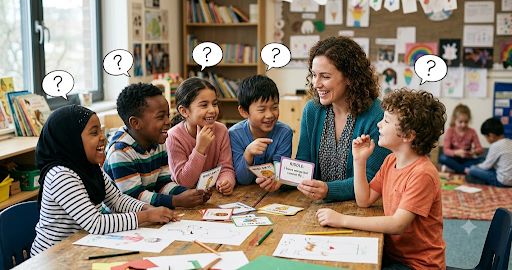
Easy riddles work best for preschoolers and younger elementary children because they use familiar objects and direct clues. Funny riddles add wordplay for family and classroom fun. “What Am I?” riddles help children combine several clues before identifying an answer. Ask children to explain how they solved a riddle — the conversation is often more valuable than the correct answer.
Table of Contents
Quick Answer
A riddle for kids is a short question or clue puzzle with a surprising answer. Riddles encourage children to listen closely, notice double meanings, test ideas and explain their thinking. This collection includes easy, funny, animal, school and “What Am I?” riddles, with answers for parents, caregivers and teachers.
Need a quick pick? Start with “What gets wetter as it dries?” for younger children, “What comes once in a minute, twice in a moment?” for older children, or the funny “Why did the bicycle fall over?” for family time.
Key Takeaways
- Easy riddles work best for preschoolers and younger elementary children because they use familiar objects and direct clues.
- Funny riddles add wordplay and make family, classroom, and car-ride activities more engaging.
- “What Am I?” riddles help children combine several clues before identifying an answer.
- Ask children to explain how they solved a riddle; the conversation is often more valuable than the correct answer.
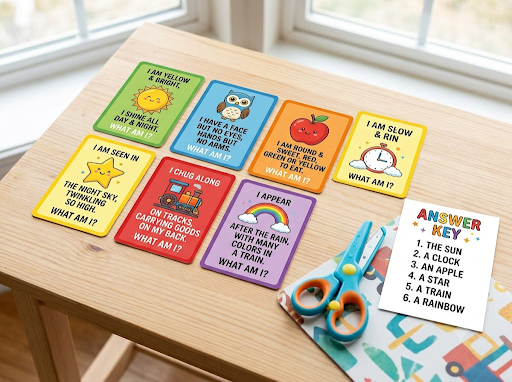
- Use the free printable riddle cards included with this article for screen-free family or classroom play.
10 Quick Riddles for Kids
| Riddle | Answer |
|---|---|
| What gets wetter as it dries? | A towel. |
| What has teeth but cannot bite? | A comb. |
| What goes up but never comes down? | Your age. |
| What is full of holes but holds water? | A sponge. |
| What kind of tree fits in your hand? | A palm tree. |
| Why was the math book unhappy? | It had too many problems. |
| What can you catch but not throw? | A cold. |
| What belongs to you but others use more? | Your name. |
| What repeats what you say but never speaks first? | An echo. |
| Which month has 28 days? | Every month. |
What Is a Riddle for Kids?
A riddle for kids is a short word puzzle that describes an object, animal, number, place, or idea without saying its name directly. The child hears the clues, thinks of possible answers, and seeks a meaning that will make each clue fit.
Example: What has hands but cannot clap?
Answer: A clock.
Why Can Riddles Be Good for Children?
Riddles are not a formal programme of learning but can provide useful opportunities for speaking, listening and word-play. "Riddles are a fun way to help children listen for word sounds, recognise multiple meanings and manipulate language," says Reading Rockets. Evidence from oral-language activities supports structured questioning, purposeful conversation and active use of vocabulary.
- Listening for important information in a clue
- Using vocabulary in context
- Noticing puns, sounds and words with more than one meaning
- Forming and testing possible answers
- Explaining reasoning in complete sentences
- Creating original clues for familiar objects
Related Talk-EarlyEd guide: Cognitive Development in Middle Childhood offers more ideas for supporting memory, reasoning and problem-solving in children ages 6–12.
How We Selected These Riddles
Talk-EarlyEd evaluated each riddle against four practical yardsticks: the wording should be clear, the answer should match the clues, the subject matter should be age-appropriate, and the collection should not include needless repetitions. Familiar classic riddles are included because children recognise and enjoy them; the explanations, organization, age guidance, and Los Angeles bonus section are original to this guide.
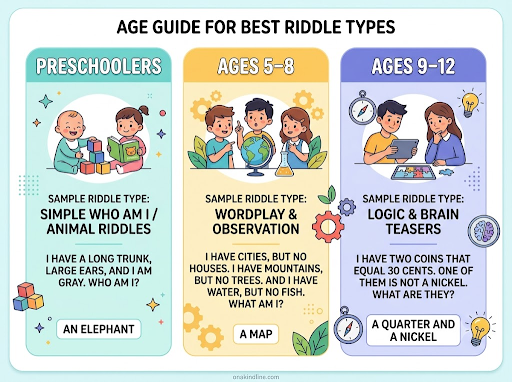
Which Riddles Are Best for Each Age?
| Age group | Best riddle types | How to help | Suggested sections |
|---|---|---|---|
| Preschoolers (3–5) | Familiar animals, foods and household objects | Read slowly, repeat clues and offer one extra hint | Easy; Animal; simple What Am I? |
| Ages 5–8 | Easy wordplay, funny riddles and direct logic clues | Ask which clue helped and let the child explain | Easy; Funny; What Am I? |
| Ages 9–12 | Language puzzles, number riddles and multi-meaning clues | Encourage more than one possible guess before revealing the answer | School & Learning; What Am I?; LA riddles |
| Mixed-age families | Short riddles with one clear answer | Let younger children receive hints while older children explain the wordplay | Quick Riddles; Funny; Animal |
Easy Riddles for Kids
These easy riddles for kids use familiar objects and clear clues. They are a good starting point for preschoolers, early readers, and children who are new to riddles.
EasyWhat has a face and two hands but no arms or legs?
Show answerHide answer
Answer: A clock.
EasyWhat has four legs but cannot walk?
Show answerHide answer
Answer: A table.
EasyWhat has teeth but cannot bite?
Show answerHide answer
Answer: A comb.
EasyWhat gets wetter as it dries?
Show answerHide answer
Answer: A towel.
EasyWhat has one eye but cannot see?
Show answerHide answer
Answer: A needle.
EasyWhat has a neck but no head?
Show answerHide answer
Answer: A bottle.
EasyWhat goes up but never comes down?
Show answerHide answer
Answer: Your age.
EasyWhat has many keys but cannot open a door?
Show answerHide answer
Answer: A piano.
Funny Riddles for Kids
These funny riddles use puns and silly answers. Read the question with a straight face, pause, and let the punchline do the work.
FunnyWhy did the student eat the homework?
Show answerHide answer
Answer: Because the teacher said it was a piece of cake.
FunnyWhat kind of tree can fit inside your hand?
Show answerHide answer
Answer: A palm tree.
FunnyWhy was the math book unhappy?
Show answerHide answer
Answer: Because it had too many problems.
FunnyWhat do you call a bear with no teeth?
Show answerHide answer
Answer: A gummy bear.
FunnyWhy did the banana go to the doctor?
Show answerHide answer
Answer: Because it was not peeling well.
FunnyWhy did the bicycle fall over?
Show answerHide answer
Answer: Because it was two-tired.
FunnyWhat kind of room has no doors or windows?
Show answerHide answer
Answer: A mushroom.
FunnyWhy are fish so smart?
Show answerHide answer
Answer: Because they live in schools.
What Am I? Riddles for Kids
“What Am I?” riddles provide several clues to a single answer. Encourage children to wait until every clue is read before guessing.
I am yellow, grow in bunches and am a popular snack. What am I?
Show answerHide answer
Answer: A banana.
I have wings, can fly and make honey. What am I?
Show answerHide answer
Answer: A bee.
I have a head and a tail but no body. What am I?
Show answerHide answer
Answer: A coin.
I am tall when I am young and short when I am old. What am I?
Show answerHide answer
Answer: A candle.
I circle Earth, reflect sunlight and seem to change shape through the month. What am I?
Show answerHide answer
Answer: The moon.
I have bark but cannot bite. What am I?
Show answerHide answer
Answer: A tree.
I appear when sunlight shines through raindrops and I show many colors. What am I?
Show answerHide answer
Answer: A rainbow.
Animal Riddles for Kids
Animal riddles help children connect clues with appearance, habitat and behavior. Ask children to add one more true clue after solving each one.
I am the largest animal in the ocean and breathe through a blowhole. What am I?
Show answerHide answer
Answer: A blue whale.
I carry my home on my back and move very slowly. What am I?
Show answerHide answer
Answer: A snail.
I have black-and-white stripes and look a little like a horse. What am I?
Show answerHide answer
Answer: A zebra.
I can change color to blend into my surroundings. What am I?
Show answerHide answer
Answer: A chameleon.
I have a long trunk and very large ears. What am I?
Show answerHide answer
Answer: An elephant.
I jump, have a pouch and am native to Australia. What am I?
Show answerHide answer
Answer: A kangaroo.
I am green, can jump and begin life as a tadpole. What am I?
Show answerHide answer
Answer: A frog.
School and Learning Riddles for Kids
These language and logic riddles are useful for morning meetings, brain breaks, classroom transitions and family quiz time.
What begins with T, ends with T and has tea inside it?
Show answerHide answer
Answer: A teapot.
I am an odd number. Remove one letter and I become even. What number am I?
Show answerHide answer
Answer: Seven.
Which month has 28 days?
Show answerHide answer
Answer: Every month.
What belongs to you but is used more often by other people?
Show answerHide answer
Answer: Your name.
What comes once in a minute, twice in a moment and never in a thousand years?
Show answerHide answer
Answer: The letter M.
Keep exploring: Things to Do in Los Angeles with Kids includes museums, parks, beaches and family activities for different ages and budgets.
How to Use Riddles With Children
Riddle of the Day
One riddle a day. Give children thinking time and then ask for two or three possible answers before providing the answer.
Use Riddles on Transitions
Ask a short riddle while kids are waiting for lunch, cleaning up, lining up, riding in the car or moving between activities.
Make Riddles a Family Game
Take turns asking riddles at dinner, on road trips or at family gatherings. 1 point for answering the riddle and 1 bonus point for explaining the clue that led to the answer.
Let Children Create Their Own Riddles
Select a familiar object and ask the child to describe it without saying what it is. A child might describe a pencil as “I am long and thin. I help you write. You use me; I shrink. What am I?”
Creative-thinking connection: The Importance of Imagination in Child Development explains how storytelling and pretend play can support flexible thinking.
Use Hints Instead of Revealing the Answer
Offer one additional clue, a category hint or two possible answers. The aim is to keep the puzzle enjoyable, not to make the child feel tested.
Use the Free Printable Cards
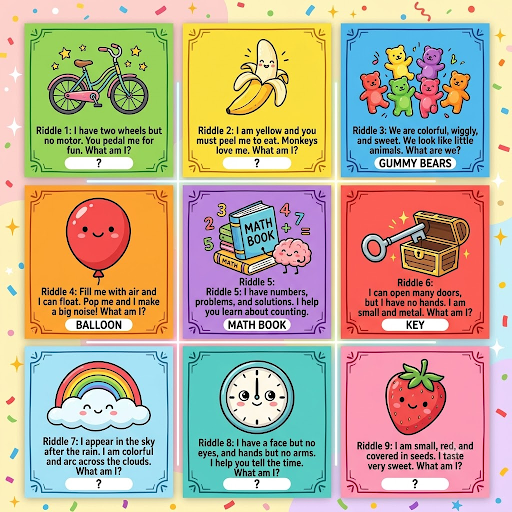
Print the companion set of 30 riddle cards, cut along the card borders and keep the answer key separate. Use them for classroom stations, family game night, travel or a newsletter download.
More Learning-Through-Play Ideas
1. The Importance of Imagination in Child Development
For storytelling and creative thinking.
2. Cognitive Development in Middle Childhood
For reasoning, memory, and problem-solving.
3. What Classes Are Considered for Child Development?
For enrichment, language, arts, and STEM activities.
4. Best Educational Toys for 2-Year-Olds
For younger children learning through play.
5. Learning Toys for 4-Year-Olds
For preschool learning, puzzles and pretend play.
6. Things to Do in Los Angeles with Kids
For local family activities and educational outings.
Discover
Frequently Asked Questions
What are some good riddles for kids?
Good riddles for kids use familiar clues and have a clear answer that feels satisfying once explained. Examples include “What gets wetter as it dries?”—a towel—and “What has teeth but cannot bite?”—a comb. Choose the difficulty based on the child’s vocabulary and age.
What is a riddle for kids?
A riddle for kids is a short clue-based word puzzle. It describes an object, animal, number, place or idea without naming it directly. The child uses listening, vocabulary, reasoning and imagination to identify the answer.
Are riddles educational?
Riddles can support playful speaking, listening and word awareness. They encourage children to notice clues, consider multiple meanings and explain their reasoning. Their value increases when adults ask follow-up questions rather than treating the activity as a speed test.
What are easy riddles for kids?
Easy riddles use familiar objects and direct clues, such as “What has a neck but no head?”—a bottle. They are useful for preschoolers, new readers and children who are still learning how riddle clues work.
What are “What Am I?” riddles?
“What Am I?” riddles describe one answer through several clues. For example: “I have pages and a cover, and I can tell a story. What am I?” The answer is a book. These riddles help children combine information before guessing.
At what age can children understand riddles?
Many children enjoy simple object and animal riddles during the preschool years. Wordplay becomes easier as vocabulary and language comprehension grow. Start with familiar clues, offer hints, and gradually introduce puns, number riddles and multi-step logic.
How can I make riddles easier for a child?
Read the riddle slowly, repeat the most important clue, identify the category and offer one extra hint. You can also give two possible answers. Avoid revealing the answer immediately; a small amount of supported thinking keeps the game enjoyable.
What is a good riddle for family game night?
Choose short riddles that work across ages, such as “Which month has 28 days?” or “What belongs to you but other people use more?” Let younger children receive hints and invite older children to explain the wordplay.
Final Thoughts
Riddles for kids offer a simple way to combine laughter, language and thinking. They require no special materials and can fit into classrooms, car rides, family dinners, waiting rooms and bedtime routines. Begin with easy riddles, add funny wordplay and invite children to create their own clues as their confidence grows.
The goal is not only to get the correct answer. It is to make listening, guessing, explaining and learning feel fun.
References
- Reading Rockets: Playing with Words - Riddles - https://www.readingrockets.org/topics/play/playing-words-riddles
- Education Endowment Foundation: Oral Language Interventions - https://educationendowmentfoundation.org.uk/education-evidence/teaching-learning-toolkit/oral-language-interventions
- Education Endowment Foundation: Teaching and Modelling Vocabulary - https://educationendowmentfoundation.org.uk/education-evidence/teaching-learning-toolkit/teaching-and-modelling-vocabulary