Key Summary
Universal TK is a free public education program for eligible four-year-olds in California. Children who turn 4 years old on or before September 1 generally qualify, and enrollment is handled by local public school districts. TK bridges preschool and kindergarten through age-appropriate learning, social-emotional growth, early literacy, math readiness, communication, and classroom confidence.
Table of Contents
Quick Answer
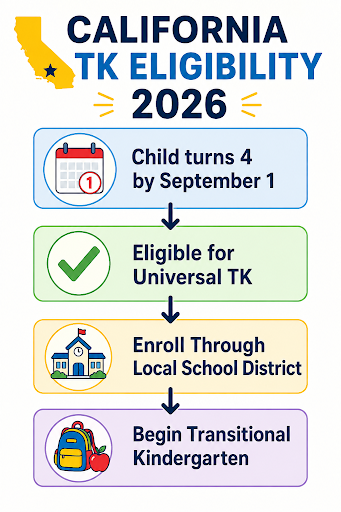
Universal Transitional Kindergarten (TK) is California's free public-school program for eligible four-year-old children. Beginning with the 2025-2026 school year and continuing into 2026, children who turn 4 years old on or before September 1 are generally eligible to enroll through participating public school districts.
If your child is turning four soon, you have probably come across the term Universal Transitional Kindergarten (TK) while researching school options in California. You may be wondering whether your child qualifies, how enrollment works, whether TK is better than preschool, or what your child will actually learn during the program.
Finding clear answers is not always easy. Eligibility rules, enrollment timelines, and district-specific information can make the process feel overwhelming, especially for first-time parents.
This guide simplifies everything parents need to know about Universal TK California 2026. You will learn who qualifies, how to enroll, what children learn in TK, how it compares with preschool and kindergarten, and how to determine whether your child is ready.
Expert reviewed by Maddie Win, an early learning and educational resources writer with experience in preschool education, school readiness, and family-friendly learning guidance.
What Is Universal TK?
Many parents hear the terms TK, Transitional Kindergarten, and Universal TK and assume they are simply another name for preschool. While both programs support early childhood development, Universal Transitional Kindergarten is a free public-school program designed to bridge the gap between preschool and kindergarten.
TK gives eligible four-year-old children an additional year of developmentally appropriate learning before kindergarten. Instead of introducing formal academics too early, the program helps children build confidence, independence, communication, and foundational school skills.
Unlike many private preschool programs that charge tuition, Universal TK is offered through participating California public schools at no cost to eligible families. Children learn in classrooms led by credentialed teachers using age-appropriate, hands-on activities.
- Early literacy and language development
- Mathematics and problem-solving
- Social-emotional learning
- Communication and collaboration
- Science exploration
- Creative expression
- Fine and gross motor development
Kindergarten readiness is not measured only by knowing letters or numbers. A child's ability to communicate, follow routines, solve simple problems, and interact positively with others is equally important.
Why California Expanded Transitional Kindergarten
For many years, Transitional Kindergarten was available only to children born within a limited eligibility window. Many families were left with a gap: their child was too young for kindergarten but did not qualify for TK.
California expanded the program into Universal Transitional Kindergarten to make free early education available to all age-eligible four-year-olds through the public school system.
The goal is simple: give every child the opportunity to build a strong foundation before starting kindergarten, regardless of family income or where they live.
- Stronger early literacy skills
- Better math readiness
- Improved communication abilities
- Greater confidence and independence
- Stronger social-emotional skills
- Smoother transitions into kindergarten
Universal TK Eligibility Requirements for 2026
For most families, Universal TK eligibility is based primarily on a child's date of birth.
Beginning with the 2025-2026 school year and continuing into 2026, children who turn 4 years old on or before September 1 are generally eligible to enroll in Universal Transitional Kindergarten through participating California public school districts.
Although Universal TK is available statewide, enrollment procedures, registration timelines, and program availability may differ between school districts. Always confirm details with your local district before enrollment begins.
| Child's Birthday | Eligible for Universal TK? |
|---|---|
| June 20, 2021 | Yes |
| August 15, 2021 | Yes |
| September 1, 2021 | Yes |
| September 2, 2021 | Usually no, next school year |
| October 10, 2021 | Usually no, next school year |
These examples are based on the general statewide eligibility rule. Individual school districts may have specific enrollment procedures or implementation details.
California TK Age Requirements
The primary purpose of TK is to provide a developmentally appropriate learning environment for children who are not quite ready for traditional kindergarten.
Instead of pushing young learners into academic expectations that may be too advanced, TK offers an additional year of growth and preparation.
| Child's Age | Typical Eligibility |
|---|---|
| 4 years old | Eligible for TK |
| 5 years old | Eligible for kindergarten |
| 6 years old | First grade |
What If My Child Misses the TK Cutoff?
If your child's birthday falls after the eligibility cutoff, they will generally need to wait until the following school year to enroll in Universal TK.
This does not mean your child will fall behind. Many parents use the additional year to support development through preschool, childcare programs, community activities, or learning experiences at home.
- Read together every day
- Practice conversations and storytelling
- Encourage learning through play
- Build independence with daily routines
- Explore numbers, shapes, colors, and letters naturally
- Participate in social activities with other children
TK vs Preschool: What's the Difference?
Preschool introduces young children to learning through play in a flexible environment, while TK serves as a bridge between preschool and kindergarten. TK helps children become familiar with a structured school setting before elementary school.
The right choice depends on your child's age, developmental needs, and educational goals.
| Feature | Universal TK | Preschool |
|---|---|---|
| Age | Eligible 4-year-olds | Usually ages 2-5 |
| Cost | Free through public schools | Often tuition-based |
| Curriculum | California public school curriculum | Varies by provider |
| Teachers | Credentialed public school teachers | Requirements vary |
| School schedule | Similar to elementary school | Flexible by provider |
| Purpose | Prepare children for kindergarten | Build early developmental skills |
Universal TK may be a good fit if your child is eligible, ready for a more structured classroom, enjoys learning with other children, and will begin kindergarten the following school year.
Preschool may still be the right option if your child is not yet eligible for TK, benefits from a smaller or more flexible environment, or needs additional time before entering a structured classroom.
TK vs Kindergarten
TK is not simply kindergarten taught earlier. It uses age-appropriate learning methods tailored specifically to younger children.
TK allows children additional time to mature before facing kindergarten expectations.
TK Focuses On
- Learning through play
- Exploration
- Social development
- Communication skills
- Independence
Kindergarten Focuses More On
- Academic instruction
- Reading readiness
- Writing skills
- Mathematics foundations
- Structured classroom routines
Benefits of Universal TK
Universal TK supports the whole child: academically, socially, emotionally, physically, and developmentally.
1. Stronger Social Skills
- Sharing
- Cooperation
- Following routines
- Resolving conflicts
- Building friendships
2. Improved Emotional Development
- Managing emotions
- Building resilience
- Developing confidence
- Practicing independence
3. Early Literacy Development
- Letter recognition
- Phonemic awareness
- Vocabulary growth
- Listening comprehension
- Storytelling skills
4. Math Readiness
- Counting
- Patterns
- Shapes
- Measurement
- Problem-solving
A successful kindergarten transition is not about how much a child already knows. It is about whether they feel confident, curious, and ready to learn.
How to Enroll in Universal TK in California
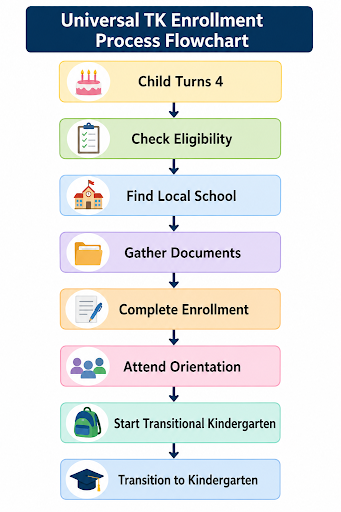
Once you have confirmed that your child is eligible for Universal TK, the next step is completing enrollment through your local public school district.
Exact procedures may vary slightly between districts, but the overall process is generally straightforward. Starting early can help you avoid last-minute delays.
- Confirm your child's eligibility
- Find your assigned local school
- Gather required documents
- Complete the enrollment application
- Submit forms before the deadline
- Attend orientation or school events
- Prepare your child for the first day
Required Enrollment Documents
Although requirements may vary by district, most families should be prepared to provide core documents that confirm age, residency, guardian information, and health records.
| Document | Why It's Needed |
|---|---|
| Birth certificate | Confirms your child's age and eligibility |
| Proof of residency | Verifies district eligibility |
| Parent or guardian ID | Confirms legal guardian information |
| Immunization records | Meets California school health requirements |
| Health forms, if required | Supports student health and safety |
Los Angeles TK Enrollment Guide
Families in Los Angeles have access to numerous TK programs through local public school districts. Parents should begin researching options several months before enrollment deadlines.
- School location
- Program hours
- Transportation availability
- Student-teacher ratio
- Family support services
Questions to Ask During a School Tour
Visiting a school before enrollment can help you feel more confident about your decision.
- What does a typical TK day look like?
- How does the program prepare children for kindergarten?
- What teaching approach does the classroom use?
- How do teachers communicate with parents?
- What support is available if a child needs extra help?
- Are meals and transportation available?
- What opportunities are there for parent involvement?
Common Enrollment Mistakes Parents Make
Even well-prepared families can make simple mistakes during enrollment. Being aware of them can help avoid unnecessary delays.
- Waiting too long to apply
- Not checking local district requirements
- Forgetting important documents
- Assuming every school follows the same process
Create a digital or printed folder with all of your child's enrollment documents before registration opens. Having everything organized can make the process much less stressful.
Is Your Child Ready for TK?
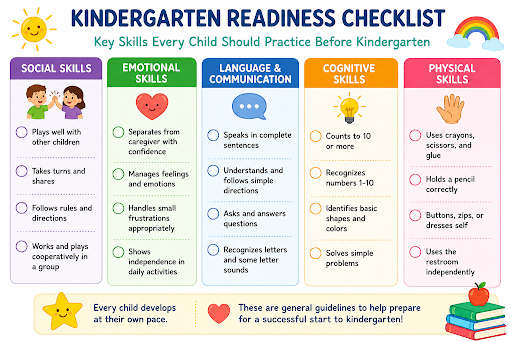
Many parents worry that their child needs to know the alphabet, count to 100, or write their name before starting Transitional Kindergarten. The good news is that Universal TK is designed to help children develop these skills, not require them beforehand.
Kindergarten readiness is about much more than academics. Children enter TK with different personalities, experiences, and developmental strengths, and teachers expect them to learn and grow throughout the year.
- Interacts with other children
- Begins sharing and taking turns
- Expresses basic feelings and needs
- Follows simple classroom rules
- Speaks in simple sentences
- Listens to short stories
- Follows one- or two-step directions
- Washes hands with minimal assistance
- Enjoys books, songs, games, and creative activities
Skills Children Develop During TK
TK supports language, literacy, early math, physical development, and social-emotional learning through developmentally appropriate classroom experiences.
| Skill Area | Examples |
|---|---|
| Language and communication | Speaking clearly, listening skills, vocabulary growth |
| Early literacy | Alphabet recognition, sound awareness, story comprehension |
| Early math | Counting, number recognition, comparing quantities |
| Physical development | Fine motor skills, handwriting readiness, coordination |
| Social-emotional learning | Self-regulation, cooperation, problem-solving |
Common Parent Concerns
Will My Child Be Bored?
Most TK classrooms are specifically designed for four-year-olds and emphasize hands-on learning.
Is TK Better Than Preschool?
It depends on the child's needs, but many families appreciate the structured environment, credentialed teachers, and free access offered through TK.
What If My Child Is Shy?
TK provides opportunities to build confidence gradually through supportive classroom experiences.
Does TK Guarantee Kindergarten Success?
No program can guarantee success, but TK can provide a strong developmental foundation.
Discover
Frequently Asked Questions
What does TK stand for?
TK stands for Transitional Kindergarten.
Is TK free in California?
Yes. Universal TK is offered through public schools at no cost to eligible families.
Is TK attendance required?
Attendance requirements vary by district, but enrolled students are generally expected to attend regularly.
Can my child skip TK and go directly to kindergarten?
If your child meets kindergarten age requirements, parents may discuss options with their school district.
Does every California school offer TK?
Most public school districts participate in Universal TK, though implementation details may vary.
Final Thoughts
Universal TK represents one of the most significant educational opportunities available to California families today. By providing children with an additional year of development before kindergarten, the program helps build confidence, social-emotional skills, academic readiness, and a lifelong love of learning.
For parents navigating school choices in 2026, understanding TK eligibility requirements, enrollment procedures, and readiness expectations can make the transition smoother and less stressful.
Whether you are exploring public school options for the first time or comparing preschool and TK programs, investing time in understanding Universal TK can help your child begin their educational journey on a strong foundation.
For related guidance, explore why early childhood education matters, find local daycare and preschool options, and developmental milestones to expect.