




Key Summary
Discover effective, age-appropriate activities to stimulate your 3-month-old’s cognitive, motor, sensory, and emotional development, while supporting early bonding and growth.
As a parent or caregiver of a three-month-old infant, you may feel uncertain about what to do during those awake windows. You might worry: “Are these little interactions meaningful? Am I helping my baby’s brain grow? Or am I missing critical stimulation?” Without purposeful engagement, those early months risk being underutilized. The window for shaping neural pathways is narrow. Babies may develop more slowly in motor skills, communication, or sensory integration if deprived of consistent, developmentally appropriate stimulation. Many caregivers feel guilt or stress wondering whether they’re doing “enough” , and they are often overwhelmed by the abundance of conflicting advice online.
This blog equips you with a comprehensive, evidence-based toolkit of activities, routines, and insights tailored to 3-month-old infants. We’ll unpack why each type of activity matters, how to implement it, when to do it, and what to watch for. You’ll also get visuals suggestions, safety pointers, and links to deeper reading, so you can engage your infant confidently and joyfully.
Table of Contents
Developmental Landscape at 3 Months
At three months, your infant is at a fascinating crossroads of early development. Physically, many infants can raise the head and chest while lying on their stomach, support their upper body with arms, and kick with legs (HealthyChildren’s “Developmental Milestones: 3 Months”) HealthyChildren.org. Their hands are opening more, fingers spreading, and they may swipe at or reach for objects
On the sensory side, vision is maturing: by three months many babies can track moving objects, shift gaze between items, and begin to discern more colors beyond high-contrast black and white. They also become more sensitive to sounds, voices, and differing textures (Seattle Children’s Hospital on toys and play) Seattle Children’s Hospital.
Cognitively and socially, infants of this age begin to coo, make vowel sounds, and respond to your facial expressions and voice inflections. They begin to show preferences in faces and voices, react more to caregivers, and start to form early social bonds.
It’s a stage of rapid neural connectivity: “simple activities such as talking, reading and singing to your baby will start them on the path to a successful life” (Building Babies’ Brains resource) buildingbabiesbrains.com. Also, researchers emphasize that play in infancy helps transition children from dependence to self-regulation as they grow (The Power of Play, AAP) AAP Publications.
Understanding this landscape helps tailor your approach: you’re not asking a baby to do too much, just enough variation, repetition, and supportive challenge to build foundations.
Core Activity Domains & Why They Matter
Here we break down major domains of activity, with rationale, sample ideas, and implementation tips.
A. Motor & Physical Activities
Why it matters: Physical movement helps strengthen neck, back, shoulder, and core muscles, preparing the baby for rolling, sitting, and crawling. It also encourages body awareness and spatial orientation. Physical activity in infancy supports healthy trajectories later in childhood (narrative review on early physical activity) PMC.




Sample activities & tips:
- Tummy Time: Place the baby on their stomach while awake and supervised, starting with short sessions (3–5 minutes) and gradually increasing. Use toys or your face as a focus to encourage head lifting and neck strength. Verywell Family+1
- Baby Push-ups / Head Lifts: While on the tummy, motivate the baby to push up on elbows (peek-a-boo beneath) or lift the head to look at you.
- Bicycle Legs / Gentle Kicks: Lay baby on the back and move their legs in gentle “pedal” motions to awaken vestibular and proprioceptive senses (Nemours)
- Supported Sitting Practice: With your support or cushions, allow the baby to experience gentle upright posture for short periods, stimulating trunk control.These early motor exercises not only strengthen muscles but also provide opportunities for responsive caregiving. For parents interested in specialized strategies for children with atypical development, you may also explore parent engagement with autistic children to see how early interactive play can be adapted for unique developmental needs.
- Gentle Reaching & Grasp Encouragement: Dangling a soft toy just within reach encourages small shoulder and arm control movements (How Wee Learn) howweelearn.com.
Each small movement session builds stamina, flexibility, and motor mapping.
B. Sensory & Tactile Exploration
Why it matters: Early sensory play shapes how infants interpret touch, texture, pressure, temperature, and proprioception, laying groundwork for later sensorimotor integration. This supports everything from fine motor to emotional regulation.
Ideas & tips:
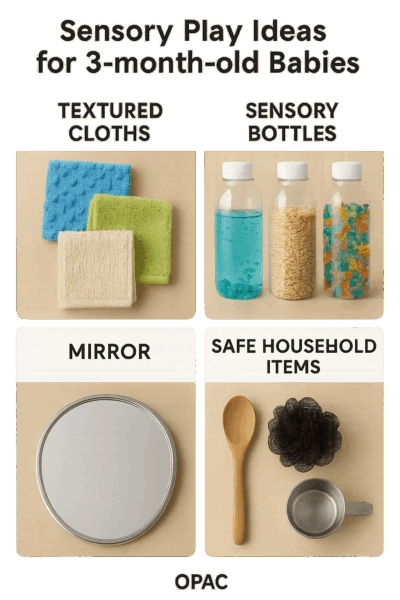
- Texture Mats or Sensory Blankets: Offer cloths, satin, fleece, crinkly paper, or soft sponge as safe textures to explore.
- Sensory Bottles / Discovery Jars: Fill sealed bottles with water, glitter, colored beads, or rice to create visually engaging tactile sounds (without choking risk).
- Safe Household Objects: Let the baby hold and mouth safe, sanitized items (e.g., silicone spatula, teething toy) to explore weight and shape.
- Temperature Contrast: Gently let them feel a cool cloth vs. a room-temperature cloth (always supervised).
- Mirror Exploration: Place a baby-safe mirror nearby so the baby can see their own hand or face (encourages tactile-visual integration).
C. Language, Voice & Social Engagement
Why it matters: Early vocal interactions form the scaffold for later language, social understanding, and emotional bonding. Interactive “serve and return” conversations strengthen neural circuits for communication. (CDC’s positive parenting) CDC
Activities & tips:
- Parentese / Baby Talk (CDS – Child Directed Speech): Use slower, exaggerated, melodic tone to talk to your baby; infants prefer this and it supports language development (Baby Talk article)
- Mimic Coos & Sounds: When baby coos or babbles, respond by repeating and expanding (“ahh → ahh-ohh”) to model turn-taking.
- Face-to-Face Chats: Sit facing baby during feedings or play, making eye contact, smiling, and talking about what you see. Engaging in vocal interactions helps infants develop social communication skills and strengthens early bonds. If you’re curious about modern approaches to enhancing early learning, insights from cutting-edge approaches to child development provide guidance on using technology, neuroscience, and evidence-based interventions to elevate interactive play.
- Reading Board Books / Simple Stories: Even though infants don’t understand the plot, hearing varied sounds and seeing images still helps neural patterning.
- Nursery Rhymes & Finger Plays: Simple rhymes (“Itsy Bitsy Spider”) with hand motions engages both motor and language domains.
These responsive interactions teach babies that communication is meaningful and build early social wiring.
D. Visual & Tracking Stimulation
Why it matters: Developing visual tracking and eye–hand coordination is pivotal in the first months. Babies must learn to shift gaze, follow moving objects, and eventually link vision to action.
Ideas & tips:
- Black-and-White or High-Contrast Cards: Because infants first discern strong contrasts, present cards or images with bold black/white patterns.
- Dangling Toys / Mobiles: Position colorful toys just above them so they can swat, track movement, or glance upward (Nemours guidance) KidsHealth.
- Slow Movement Following: Move a toy slowly left-right or up-down while within their visual field; encourage them to track it.
- Mirror Tracking: Observe their eyes following their own hand or face in the mirror.
- Tracking Soft Balls / Scarves: Dangling a scarf or soft ball and gently moving it gives the baby targets to visually follow (Raising Children suggestions) Raising Children Network. Visual tracking activities support cognitive growth and coordination. Understanding the wider social context can also inform caregiving approaches. For example, research on the impact of parental incarceration on child development highlights how stress, separation, or trauma can influence early bonding, which is essential to consider when tailoring stimulation activities.
Over time, you’ll notice the baby’s gaze becomes smoother and more accurate.
E. Musical, Rhythmic & Auditory Play
Why it matters: Rhythm and auditory experiences foster early brain connectivity, pattern recognition, and emotional resonance. Musical exposure in infancy is linked to enhanced cognitive and linguistic skills.
Ideas & tips:
- Soft Singing / Lullabies: Use a soothing voice and repeat melodies; babies often recognize nursery songs by repetition.
- Rattles / Bells: Provide (safe) sound-making toys they can shake or you can shake within their hearing range.
- Clapping Games & Rhythmic Beats: Gentle claps or tapping surfaces to a beat help infants predict patterns.
- Environmental Sounds: Narrate everyday noises (“listen, the kettle is whistling”) to help them link sound to source.
- Instrument Sounds: Let them hear soft maracas, xylophone chimes, or soft drums from a moderate distance.
Sound variation stimulates auditory pathways and primes musical and language domains.
Sample Daily Routine & Activity Table
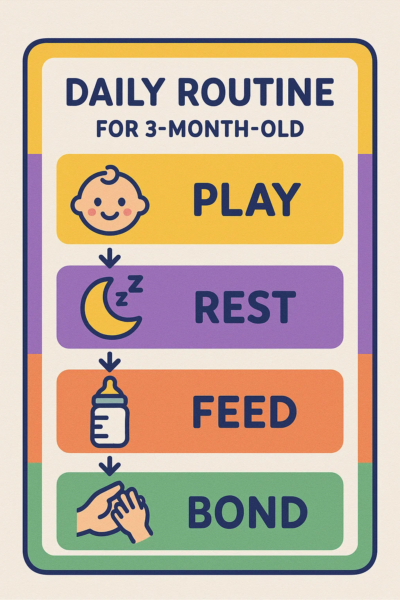
Here is a sample structure you might adapt. (Always follow baby’s cues—flexible is key.)
Time | Activity Type | Example & Notes |
Upon waking (after feeding) | Tummy time + visual tracking | Place baby on tummy, dangle a toy, encourage head lifts (start with 2–3 mins) |
Mid-morning | Sensory play | Soft texture cloths, sensory bottles, safe object exploration |
Late morning | Vocal / face time | Sit face to face, talk, coo, read a short board book |
Before nap | Gentle movement + language | Bicycle legs, supported sitting, sing lullaby |
After nap | Auditory / music play | Use rattle, bells, or sing rhythmic songs |
Afternoon | Combined play | Tummy or back play with visual toys, mirror time, responsive conversation |
Evening (pre-bed) | Calm interaction | Soft singing, cuddle while reading, gentle rattles |
Night awakenings | Quiet social cueing | Soothing voice, responsive interaction if awake but calm |
Safety Guidelines & Practical Tips
- Supervision always: Never leave baby unattended, especially during tummy time or with toys.
- Timing matters: Don’t start tummy time immediately after feeding (wait ~30 minutes) to avoid discomfort (Healthy Young Minds) Healthy Young Minds.
- Toy safety: Avoid toys with small parts, strings, or anything that can detach and cause choking.
- Limit overhead crib toys: Do not hang loose items over cribs (risk of entanglement) (Nemours)
- Watch cues: If the baby starts fussing, turning head away, arching back, that’s a signal to pause or switch activity.
- Alternate postures: Don’t keep baby in one position too long—vary tummy, back, side-lying (rotating).
- Moderate stimulation: Overwhelm can lead to fussiness, so keep changes gradual.
- Safe space: Use a firm, padded surface, avoid soft bedding or unstable surfaces.
- Health checks: Always consult a pediatrician if the baby shows unusual delays, persistent refusal to move head, or asymmetry.
Troubleshooting Common Challenges
Issue: Baby hates tummy time / cries
- Try shorter intervals (30s–1 min) and build up gradually.
- Place it on your chest or lap initially for comfort.
- Use a mirror or attractive toy to draw attention.
- Switch to side-lying, then transition to tummy.
- Make it playful: sing, smile, or do peek-a-boo.
Issue: Baby loses interest quickly
- Rotate toys every few minutes to refresh novelty.
- Use interactive vocal prompts (“can you find the bell?”).
- Combine domains: move a toy (visual) while talking (vocal) while gently tapping (tactile) to engage multiple senses.
Issue: Baby sleeps through “awake” windows
- Allow nap breaks; some babies need longer rest.
- Try during peak wakefulness (mid-morning or gentle stretching after feeding).
- Use gentler stimuli to coax awake period—soft sounds, gentle light.
Issue: Concerned about delays
- Refer to developmental milestones (HealthyChildren, Nemours) HealthyChildren.org+1.
- Track progress weekly.
- Consult a pediatrician if at 4–5 months the baby isn’t making head lifts, tracking, or responding to voice.
- Consider early intervention services if concerns persist.
- Placing images between sections (e.g. before section 3 or in the sample routine section) helps break text and visualize actions.
Frequently Asked Questions
How much total awake activity should a 3-month-old get daily?
There’s no fixed total; aim for several short (2–10 minute) windows across the day, adding up to 30–60 minutes of alert interaction, broken into manageable chunks per your baby’s cues.
When should I introduce music or toys?
You can begin immediately: rattles, soft toys, gentle music are all fine as long as they’re safe, age-appropriate, and supervised.
Can I enroll my baby in swimming classes now?
Some infant swim programs begin around 3–4 months when head control is sufficient (infant swimming guidelines). Consult your pediatrician and ensure classes follow infant safety protocols.
What if my baby doesn’t respond or seems disinterested often?
Some days are less alert, respect that. Try a different domain, lower stimulation, or return later. If consistent lack of response continues, discuss with the pediatrician.
Do I need special toys or equipment?
No, many effective activities use your voice, hands, a mirror, soft fabrics, and safe household objects.
Final Thoughts
Every minute of interaction, even a few coos, tummy time attempts, or soft songs, matters tremendously in shaping your baby’s early development. The key is variety, consistency, responsiveness, and following your infant’s cues. By combining motor, sensory, vocal, visual, and musical activities, you build a rich developmental tapestry.
References
HealthyChildren. Developmental Milestones: 3 Months.https://www.healthychildren.org
/English/ages-stages/baby/Pages/Developmental-Milestones-3-Months.aspx
Nemours KidsHealth. Learning, Play, and Your 1- to 3-Month-Old.https://kidshealth.org/en/parents/
learn13m.html
CDC. Positive Parenting Tips: Infants (0–1 years).https://www.cdc.gov/child-development/positive-parenting-tips/infants.html
The Power of Play: A Pediatric Role in Enhancing Development in Young Children (AAP) https://publications.aap.org/pediatrics/
article/142/3/e20182058/38649/The-Power-of-Play-A-Pediatric-Role-in-Enhancing
Building Babies’ Brains. Resources for Ages 0–3 Months.https://buildingbabiesbrains.com
/resources/0-to-3-months/
Physical activity in infancy and early childhood https://pmc.ncbi.nlm.nih.gov/articles/
PMC10244791/
How Wee Learn. “Learning Activities for 3 Month Old Babies https://www.howweelearn.com/learning-activities-3-month-old-babies/
Raising Children Network: Play ideas for baby cognitive development
Baby Talk https://en.wikipedia.org/wiki/Baby_talk
Seattle Children’s Hospital: “Toys and Play: Birth to 12 Months https://www.seattlechildrens.org/health-safety/parenting/toys-and-play-birth-to-12-months
Activities For 3 Month Old Baby: Learning And Development https://www.healthyyoungminds.com/
activities-for-3-month-old/
Comments are closed