



Key Summary:
Culture shapes how children think, feel, and grow. It influences parenting, learning, behavior, and relationships in powerful ways. This blog explores how cultural values impact child development and offers insights into parenting styles, communication, and identity across different cultural settings.
Every parent wants to raise a confident and capable child, but what if the blueprint for success looks vastly different across cultures? Many parents and educators remain perplexed by the fact that children from different cultural backgrounds respond particularly to the “same” stimuli, whether it be the way they express emotion, interact with authority, routes they take while learning, etc. This confusion arises largely due to a lack of cultural understanding.
The reality is, culture is not simply background noise; it shapes and influences the ways children think, feel, and behave. Family structure & discipline, language, and identity, all cultural aspects, are ingrained, deep-rooted norms that follow children throughout their identity development.
This blog will explore the ways culture impacts child development, with research backing those assertions and examples of linked parenting practices to be able to support every child in your care, regardless of their culture.
Table of Contents
What is Culture, and Why Is It Important in Early Childhood
Culture is the suite of behaviors, beliefs, values, and norms a group of people generates at a particular time and place and passes on to the next generation. For children, culture serves as a framework to understand their environment and helps them construct an understanding of what is thought to be “normal” or “expected.” Culture shapes the content of a child’s learning, how children learn, as well as how children are expected to behave within various social contexts.
Children who grow up in collectivist cultures, such as Japan, China, or many places in Africa, are typically acculturated to value community, obedience, and social harmony to varying degrees.
In other parts of the world where individualist cultures predominate, such as in the US, Canada, or many Western European countries, children are acculturated to value independence, self-expression, and personal accomplishments. The distinctions between collectivism and individualism will not only shape one’s behavior but can also shape how we respond to emotional situations, learning pace, and social identity, all of which we will discuss in the subsequent sections.
Parenting Across Cultures: Discipline, Values & Social Norms
Parenting practices are deeply affected by cultural values. For example, in many Asian cultures, children are raised with a strong emphasis on the honor of elders and educational achievements. In contrast, Western rearing can focus more on the nutrition of personality and emotional development. These basic beliefs affect how children behave and experience discipline.
According to this study from Harvard University, the parenting environment, including cultural expectations, can affect gene expression in the brain of a developing child. Therefore, cultural rearing does not shape only behavior; It can also affect biology
Important Cultural Disparities in Parenting:
- Discipline: Authoritarian (common in Asia or Africa) versus authoritative (common in the West) parenting styles.
- Transmission of values: systems based on honor, shame, or guilt.
- Family structure: models of extended versus nuclear families.
- Direct (low-context) versus indirect (high-context) communication styles.
These variations contribute to the explanation of why certain cultural contexts may benefit more from methods like gentle parenting than others.
Cultural Influence on Learning and Cognitive Development
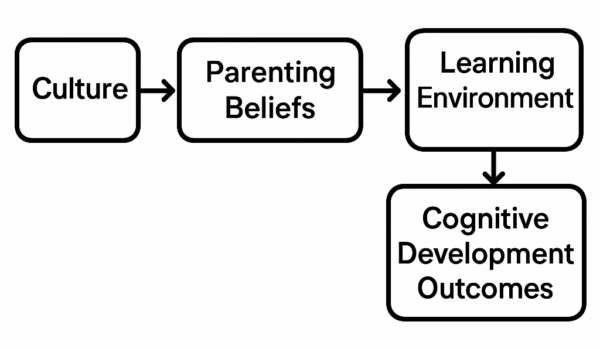
Learning is not a universal process. Cultural norms have an impact on how kids approach collaboration, problem-solving, and academic success. In certain cultures, rote memorization and deference to authority are the norm, but in others, inquiry-based learning and creativity are valued.
A study by UNESCO states that cognitive development is heavily influenced by environment and cultural input. Children of resource-rich, literacy-centered cultures often show advanced oral arguments, while more community-focused cultures lead to excellence in group problems and social responsibility.
These interactions are essential for teachers, as culturally responsible teaching can dramatically improve student results. Including familiar cultural symbols, languages, and communication styles can promote better engagement and cognitive development in multicultural classes.
Socialisation and Emotional Expression in Various Cultures
Children’s emotions, as well as how and when they can express them, are shaped by their culture. While expressive behavior is viewed as normal and healthy in some cultures (such as the U.S. or Brazil), others (like Japan) encourage children to be emotionally reserved and respectful.
According to research by the National Scientific Council on the Developing Child, carer modeling and cultural expectations influence emotional regulation at a young age. Social resilience, conflict resolution, and emotional intelligence are all impacted in the long run by this.
Socialization is also impacted. Children raised in collectivist cultures are taught to value interdependence and harmony within the group. Western kids, on the other hand, are frequently taught how to assert themselves, which has an impact on everything from leadership development to peer relationships.
Cultural Belonging and Identity Formation
A child’s cultural background is closely linked to their sense of self. Early childhood is when cultural identity development starts, and adolescence is when it becomes more noticeable. Strong cultural values help children develop more stable identities, which benefits their emotional and mental health.
Children who are raised in one culture but reside in another, known as bicultural children, frequently manage “dual identities,” which can be both enlightening and difficult. Bicultural youth exhibit greater adaptability and wider worldviews, but they may also experience feelings of cultural confusion or alienation, according to a Pew Research study.
Parents and educators can support identity formation by celebrating heritage, validating cultural expressions, and encouraging healthy peer interactions. Approaches like positive parenting are particularly effective in guiding children through this process with empathy and openness.
The Function of Culture in Language and Communication
One of the most obvious areas where culture has an impact is language development. Code-switching skills are frequently developed in children raised in multilingual settings, and verbal IQ and vocabulary growth can be accelerated in language-rich cultures. However, communication styles also vary, so it’s not just language acquisition.
High-context cultures (e.g., China, Nigeria) rely on nonverbal cues and shared understandings, while low-context cultures (e.g., Germany, U.S.) value directness. These differences influence how children learn to ask for help, express disagreement, or respond to instructions.
Key Cultural Influences on Child Development
Aspect | Individualistic Cultures | Collectivist Cultures |
Parenting Style | Authoritative, nurturing independence | Authoritarian, obedience-focused |
Emotional Expression | Encouraged, verbal | Controlled, contextual |
Learning Approach | Inquiry-based, creative thinking | Memorization, respect for authority |
Socialization Goals | Self-reliance, autonomy | Harmony, group loyalty |
Language Development | Emphasis on verbal skills | Emphasis on listening and context |
Discipline Practices | Reasoning and negotiation | Rules, consequences, respect for hierarchy |
Frequently Asked Questions
Can culture influence a child's emotional intelligence?
Yes, cultural norms dictate how emotions are expressed, perceived, and regulated—key components of emotional intelligence.
How can educators support multicultural development?
By embracing culturally responsive teaching, incorporating diverse examples, languages, and interaction styles.
Is it possible to blend different cultural parenting styles?
Absolutely. Many bicultural families blend techniques like gentle parenting with traditional discipline in a culturally sensitive way.
Final Thoughts
Culture is not a backdrop; it is an active, dynamic force that shapes how children grow, relate, and thrive. From emotional health to academic performance and social belonging, cultural influences must be acknowledged and embraced. Whether you’re a parent, teacher, or caregiver, the key is to remain open, observant, and inclusive. Understanding how culture affects child development not only fosters healthier kids but also builds stronger, more empathetic communities.
References
- Harvard Center on the Developing Child. What is Epigenetics https://developingchild.harvard.edu/resources/what-is-epigenetics-and-how-does-it-relate-to-child-development/
- UNESCO. Global Education Monitoring Report https://unesdoc.unesco.org/ark:/48223/pf0000233101
- National Scientific Council. Early Experiences and Brain Development https://developingchild.harvard.edu/resources/early-experiences-can-alter-gene-expression-and-affect-long-term-development/
Comments are closed